

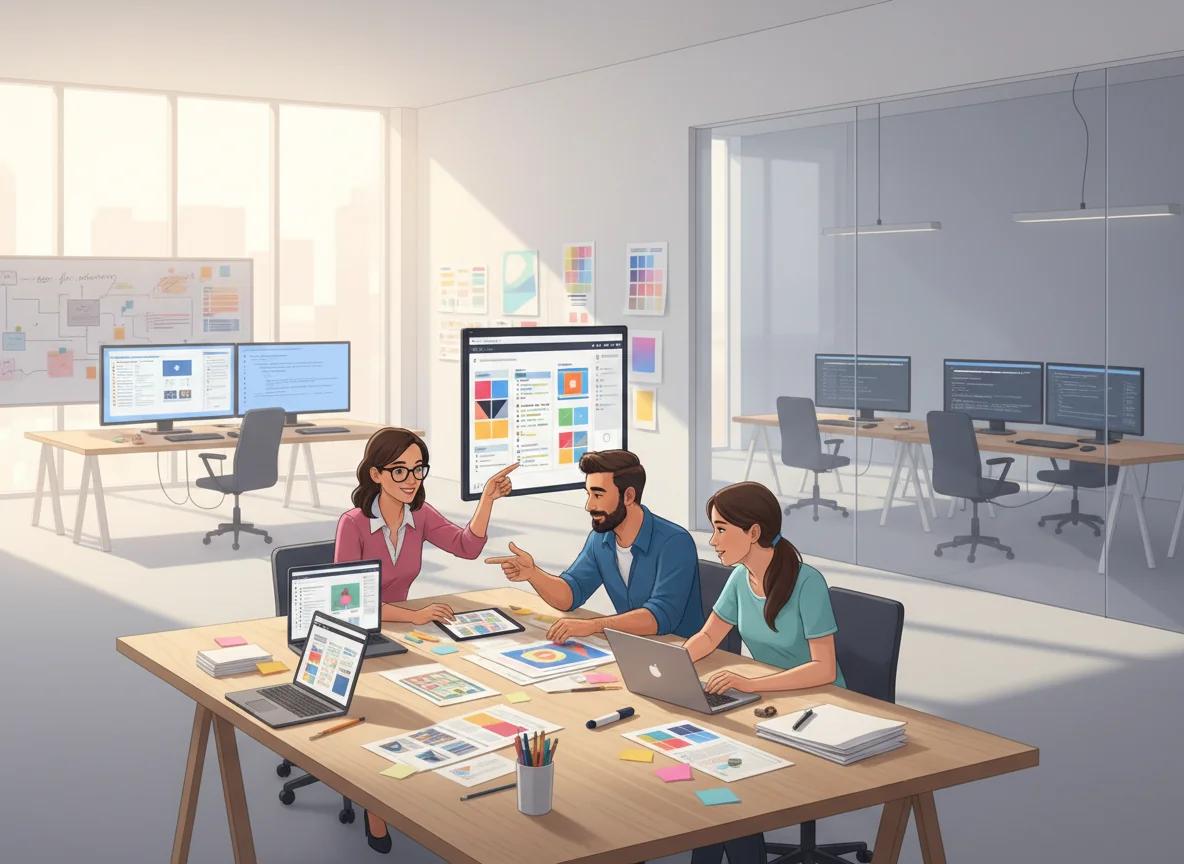
Teams rarely Google “web development vs web design” for fun. You search it when budgets are tight, timelines are real, and the wrong decision could delay growth by a quarter. In 2026, the lines between UX design, front-end engineering, full‑stack development, and ongoing digital marketing are blurrier than ever. Yet buying the wrong service package is still painfully common.
This article cuts through the jargon. Instead of textbook definitions, we’ll map web design and web development to concrete business situations: launching a D2C brand in Kerala, scaling a SaaS product for the US market, modernising a legacy site that bleeds leads, or testing an idea with a no‑code MVP. You’ll see when you truly need UX only, when full‑stack engineering is non‑negotiable, and when you should demand an integrated team.
We’ll also show how a web design and development company like Riolabz structures projects across India, the UK, and the USA, and what that means for your budget, risk, and roadmap. By the end, you should be able to shortlist partners with confidence—and know exactly what to ask for on your first discovery call or RFP.
For years, agencies blurred “web design” and “web development” into one catch‑all phrase. That’s now a liability. In 2026, each discipline has specialised enough that treating them as synonyms leads to mis-scoped projects, fragile code, and designs that don’t convert.
Web design today is primarily about experience and perception. It includes UX research, information architecture, wireframing, UI design, interaction patterns, and accessibility. Designers decide how users flow, what they see, and how your brand feels across devices. Tools: Figma, Sketch, Adobe XD, user testing platforms.
Web development is about implementation and performance. Front‑end developers turn designs into responsive interfaces (HTML, CSS, JavaScript, frameworks like React or Vue). Back‑end developers handle databases, business logic, integrations, security, and scalability (Node.js, PHP/Laravel, Python/Django, etc.). Full‑stack teams connect both.
Three market shifts make this distinction more important in India and globally:
So the right question is no longer “design or development?” but “which mix of UX, front‑end, and back‑end does my use‑case require?”
Sometimes, starting with design alone is the smartest move. Especially for founders and product leaders still validating a concept or aligning stakeholders.
Good candidates for design‑only engagements include:
At Riolabz, we often see Kerala‑based SMEs jump straight into development because “we already know what we want.” Two months later, they discover that customers navigate differently, pricing is misunderstood, or forms are abandoned. Fixing this post‑build is costly.
A focused UX & UI design phase typically delivers:
You can then take these assets to an in‑house dev team, a different vendor, or back to Riolabz for full‑stack implementation. This staged approach de‑risks build costs and aligns everyone around clear flows and success metrics.
On the other side, some organizations already have solid UX and UI assets or operate in contexts where design changes are minor compared to engineering needs. Here, full‑stack web development is the priority.
Common full‑stack‑first scenarios:
Riolabz often engages with UK or US clients who bring their own design systems but lack an engineering partner who can turn those into scalable, SEO‑ready applications. In these cases, our team focuses on:
If your brand is mature and your main problem is stability, speed, or functionality, full‑stack development possibly with light UX optimisation is the more efficient investment than a full redesign.
For most growth‑stage organisations, the real answer isn’t “web development vs web design” but “cross‑functional web design and development.” That’s especially true when your website or product is a primary revenue channel.
You almost always need both when:
Consider a mid‑sized retailer in Kochi moving from a brochure site to full eCommerce. If you hire only designers, you risk a beautiful store that loads slowly, breaks during sales, or fails basic SEO. If you hire only developers, you risk a functional but confusing checkout that leaks revenue.
Integrated teams like Riolabz solve this by structuring projects around shared goals, not deliverables: conversion rate, lead quality, retention, and lifetime value. Designers and engineers work together from discovery onwards, trading off animations versus performance, or content depth versus layout simplicity.
The result isn’t just a site that “looks good and works.” It’s a platform built on SEO‑ready architecture, clear user journeys, and code that your team can maintain and extend for years.
Abstract advice is helpful; concrete stories are better. Here are three representative scenarios taken from the kinds of projects Riolabz delivers across India, the UK, and the USA.
Use‑case 1: Kerala B2B manufacturer going global
They had a basic brochure site with poor mobile usability and almost no organic traffic. The decision: full redesign + custom web development. UX led with audience research (distributors vs end‑buyers), then development implemented a fast, multilingual, SEO‑optimised site integrated with a CRM.
Use‑case 2: US SaaS team with strong in‑house product design
Their designers owned the product UI but needed help with a marketing site, billing integration, and performance. They chose full‑stack development only. Riolabz built a headless CMS, optimised Core Web Vitals, and wired analytics into every funnel step.
Use‑case 3: Early‑stage D2C brand testing an idea
With limited budget and no clarity on positioning, they started with a UX & design sprint: messaging, prototypes, and a tight design system. A lightweight no‑code implementation validated demand; only then did they commission a fully custom website development project.
The pattern: maturity and risk drive decisions. The less validated your model, the more you should invest in UX first. The more validated and mission‑critical your digital channel, the more you need integrated design and engineering from a web design and development company that understands scale.
Beyond buzzwords, your choice between design, development, or both comes down to three constraints: budget, timelines, and risk appetite.
Budget
A design‑only phase is usually the most affordable entry point, ideal for startups in Kerala and elsewhere. Full‑stack builds are more expensive but, when done right, more cost‑effective than patchwork fixes. Beware of ultra‑cheap offers: they often ignore UX research, SEO architecture, or security costs that show up later as lost revenue or re‑builds.
Timelines
Design‑only engagements can run 2–6 weeks for a typical marketing site. Full custom website development may take 8–16 weeks depending on complexity, integrations, and content readiness. Combined projects can proceed in overlapping tracks if your partner is organised.
Risk
Choosing design first de‑risks user acceptance but delays go‑live. Jumping into development without validated UX increases launch risk. An integrated approach, like Riolabz uses, staggers risk: quick low‑fidelity prototypes, then development sprints with frequent demos, analytics, and QA on real devices.
In 2026, additional risk factors include:
The right partner won’t just quote you a price; they’ll map these constraints to a phased roadmap that fits your reality.
Once you’re clear on whether you need UX, development, or both, the next challenge is choosing a partner. This is where many RFPs fail: they list features, but not outcomes.
Start with a sharp brief:
Then evaluate agencies on:
Riolabz differentiates itself by combining custom website development, mobile app development, and digital marketing under one roof for growth‑oriented clients across Kerala, the UK, and the USA. That means your web design vs web development decision happens inside a bigger conversation: search strategy, analytics, and product roadmap. If you’re ready to move from research to action, your next step isn’t “find a coder” or “hire a designer” it’s to schedule a discovery call with a team that understands how all of these pieces fit together.
Understanding web development vs web design isn’t an academic exercise; it’s a way to invest wisely in growth. In 2026, successful digital teams don’t ask, “Do we need design or development?” They ask, “What combination of UX, engineering, and marketing will move our metrics fastest with acceptable risk?”
If you’re a founder in Kerala, a marketing leader in Bangalore, or a product owner in London or New York, your next step is simple: map your current constraints UX confusion, technical debt, slow performance, or stagnant leads to the right mix of services. Then choose a partner capable of delivering that mix under one strategic roof.
Riolabz helps growing businesses build that roadmap: from UX discovery and custom web development to SEO and ongoing optimisation. When you’re ready to turn clarity into a launch plan, a short discovery call can save you months of trial and error.

Web design focuses on how a website looks, feels, and flows for users. It includes UX research, wireframes, UI layouts, typography, colours, and interaction patterns. Web development turns those designs into a working product using code. Front‑end developers build the visible interface; back‑end developers handle databases, logic, and integrations. In practice, you need design to ensure the experience is clear and persuasive, and development to ensure it is fast, secure, and scalable. Many projects fail because they over‑invest in one side and under‑invest in the other.
You probably need custom website development if your current site limits growth in obvious ways: slow load times, poor mobile experience, difficulty adding features, or weak integration with tools like CRM, ERP, or marketing platforms. It’s also essential if your business model is complex (B2B portals, marketplaces, multi‑language sites) or your website is a primary revenue channel. If you’re only changing content and visuals on a simple brochure site, a lighter redesign or CMS theming might be enough. A good agency will audit your current setup and recommend the minimum viable customisation that meets your goals.
Yes, but it increases coordination risk. Hiring designers and developers separately can work if you have strong internal product or project management and clear documentation. Designers must deliver precise, developer‑ready assets; developers must respect design intent and ask for clarifications early. Many businesses in India and abroad underestimate the communication overhead and end up with gaps between design and build. Working with an integrated web design and development company like Riolabz simplifies this: one team owns the entire experience, from UX to deployment and optimisation.
Timelines vary by scope, but for a growth‑oriented business website you can expect roughly 10–16 weeks end‑to‑end. A focused UX & UI design phase might take 2–6 weeks depending on research depth and number of templates. Development, including front‑end, back‑end, integrations, and testing, often takes another 6–10 weeks. Large portals or complex platforms can extend beyond this. Delays most often come from content bottlenecks and slow decision‑making, not just coding. A structured partner like Riolabz will break the work into milestones so you see progress and can validate early.
Low‑code tools and website builders are useful for early experiments, simple landing pages, or very small businesses with limited budgets. They let you move fast, but you trade away flexibility, performance, and deep SEO control. If you rely on organic traffic, need custom workflows, or plan to scale to new markets, a custom website development approach becomes more attractive. Many Riolabz clients start on templates or builders, then transition to custom architecture once they hit constraints—URL structures they can’t change, slow pages they can’t fully optimise, or integrations they can’t implement.