


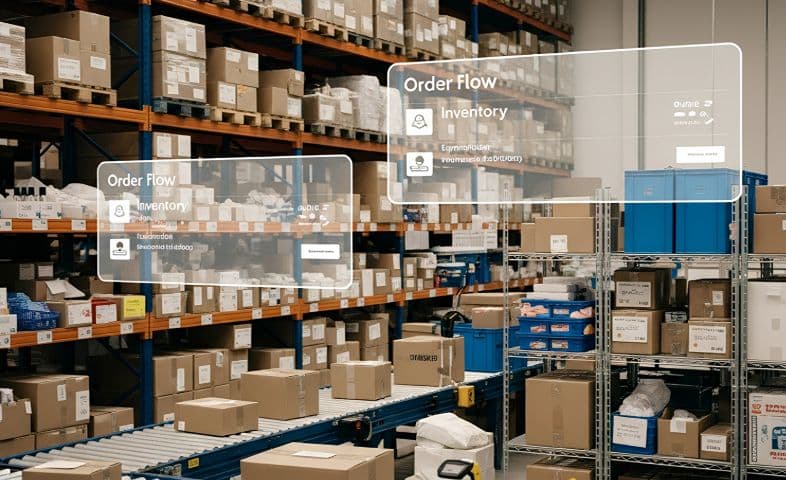
Ecommerce website development at Riolabz focuses on building scalable, stable, and operationally reliable online commerce platforms. Our approach prioritises structured architecture, secure transactions, predictable workflows, and long-term platform ownership.
This service is designed for organisations that treat ecommerce as a core business system, not a one-time website launch. Decisions around architecture, data flow, and integrations are made to support real operations such as inventory management, fulfillment, payments, and future expansion.
Unlike template-driven storefronts, structured ecommerce development ensures performance, flexibility, and continuity as the business grows.
Ecommerce website development is the structured process of building online systems that handle product listings, orders, payments, inventory, customer management, and post-purchase operations within a single, unified platform.
It goes well beyond a visual storefront. A properly built ecommerce platform manages product catalog logic, cart and checkout flows, payment gateway connections, user roles, fulfillment integrations, and backend administration, all designed to handle growth and operational complexity without repeated rebuilds.
Template-based solutions prioritise speed and low upfront cost but trade away flexibility, data control, and long-term scalability. A professionally developed ecommerce system is built around how your business operates, not around what a platform template permits.
Custom ecommerce website development means building your store from the ground up, or engineering a platform around your specific workflows — rather than adapting your business to fit a pre-built template.
It is the right choice when your requirements include complex product structures (configurable products, subscriptions, bundles), custom pricing and discount logic, multi-role user access, unique checkout flows, or integrations with ERP systems, CRMs, or logistics platforms.
Custom development gives you full ownership of architecture and data, no vendor lock-in, and the ability to evolve the platform as your business scales — without paying for a complete rebuild every few years.
| Your situation | Custom build | Shopify / WooCommerce template |
|---|---|---|
| Unique checkout or pricing logic | ✓ Right choice | Limited |
| ERP / CRM / logistics integrations | ✓ Right choice | Plugin-dependent |
| Multi-vendor marketplace | ✓ Right choice | Workaround needed |
| Standard product catalog, fast launch | Overkill | ✓ Right choice |
| Budget under ₹50,000 | Not suitable | ✓ Right choice |
| High transaction volume, performance-critical | ✓ Right choice | Scaling risk |
| Long-term platform ownership, no lock-in | ✓ Right choice | Vendor-dependent |
Depending on your business requirements, budget, and growth plans, Riolabz develops ecommerce stores on the following platforms, or builds fully custom solutions on modern web stacks.
| Platform | Best for | We offer |
|---|---|---|
| Shopify | Fast launch, standard catalogs, D2C brands | Custom theme, app integrations, Shopify Plus |
| WooCommerce | WordPress-based stores, content-heavy commerce | Custom plugins, theme dev, performance optimisation |
| Magento / Adobe Commerce | Large catalogs, B2B, enterprise commerce | Full development, module customisation, migration |
| Custom (Laravel / React / Node) | Complex workflows, unique integrations, headless | Full-stack custom build, API-first architecture |
| Headless Commerce | Omnichannel, high-performance storefronts | Decoupled frontend (Next.js) + headless backend |
Not sure which platform fits your business? Our consultation process starts with requirements analysis, not a sales recommendation.
Structured product listings with categories, attributes, variants, bundle logic, subscription products, pricing tiers, and inventory controls across single or multiple warehouses.
Conversion-optimised checkout flows: single-page checkout, guest checkout, one-click reorder, abandoned cart recovery, and checkout logic customised to your business rules.
Secure integration with: Razorpay, Stripe, PayPal, CCAvenue, PayU, Paytm, Google Pay, Apple Pay, and UPI. Multi-currency support and international payment routing available for cross-border commerce.
Native connectivity with ERP systems (SAP, Tally, Zoho Books), CRM platforms (Salesforce, HubSpot, Zoho CRM), logistics providers (Shiprocket, Delhivery, FedEx), and marketing tools (Klaviyo, Mailchimp, Meta Pixel, Google Ads, GA4).
Role-based access for store administrators, warehouse teams, customer support, vendors, and finance, with audit logs and permission controls.
Core Web Vitals compliance, mobile-first architecture, SSL, PCI DSS-aligned payment handling, structured data (product schema, breadcrumbs, review schema), canonical URL management, and Google Merchant Center integration.
Vendor onboarding flows, seller dashboards, commission logic, product approval workflows, and payout management, built as custom systems when standard platforms fall short.
The cost of ecommerce website development depends on the platform, the complexity of your catalog, integrations required, and the level of custom design and logic involved. Below are indicative ranges to help with planning.
| Type | Indicative range | Typical scope |
|---|---|---|
| Starter store | ₹50,000 – ₹1,50,000 | Shopify/WooCommerce, standard catalog, basic gateway, responsive design |
| Business store | ₹1,50,000 – ₹5,00,000 | Custom design, 3–5 integrations, multi-role admin, performance optimisation |
| Custom / enterprise | ₹5,00,000+ | Full custom build or headless, ERP/CRM integration, complex catalog logic, B2B features |
These ranges are indicative. The most accurate way to get a cost estimate is through a structured requirements consultation, we scope before we quote.
A structured process is what separates ecommerce platforms that remain stable at scale from those that accumulate technical debt. Our delivery follows five defined phases.
| Phase | What happens | Typical duration |
|---|---|---|
| 1. Planning & Architecture | Requirements, data structures, integrations, platform selection | 1–2 weeks |
| 2. Design & UX | Wireframes, UI design, mobile-first layouts, CRO-focused checkout flows | 1–3 weeks |
| 3. Development & Integration | Frontend, backend, payment gateways, third-party systems — built in sprint phases | 4–16 weeks |
| 4. QA & Performance Testing | Functional, load, and security testing; Core Web Vitals checks | 1–2 weeks |
| 5. Launch & Support | Controlled deployment, monitoring, AMC plans, ongoing enhancements | Ongoing |
| Industry | What we typically build |
|---|---|
| Fashion & apparel | Size/colour variant systems, lookbook integration, returns management |
| Electronics & gadgets | Spec-heavy product pages, comparison tools, warranty management |
| Grocery & FMCG | High-volume catalog, slot-based delivery, subscription orders |
| Healthcare & pharma | Prescription handling, compliance, age verification, secure checkout |
| B2B wholesale | Tiered pricing, MOQ logic, quote requests, credit terms, ERP sync |
| Home & furniture | Custom product configurators, room visualisation, lead-time management |
Riolabz's ecommerce website development service is suited for:
Unstructured ecommerce builds often lead to technical debt, performance issues, and repeated redevelopment. Structured development reduces platform risk by establishing clear architecture, maintainable codebases, and predictable upgrade paths.
A well-built ecommerce system supports growth without compromising stability. It allows new integrations, expanded product lines, and increased transaction volumes without disrupting existing operations. Long-term continuity is maintained through controlled updates rather than reactive fixes.
Ecommerce platforms often operate as part of a broader digital ecosystem. Teams frequently align ecommerce systems with core websites through Web Design and Development.
Marketing visibility and organic traffic growth are often supported through SEO and Digital Marketing.
Mobile-first commerce experiences may also extend into Mobile Application Development.
Ecommerce website development decisions have long-term operational and financial impact. A structured consultation helps evaluate business requirements, platform fit, integration needs, and scalability expectations before development begins.
The objective is clarity, ensuring the ecommerce system aligns with how the business operates today and how it plans to grow tomorrow.